

When we opened our first-ever Fiksuruoka Store in Espoo, it marked a completely new chapter for us. Until now, everything we built lived online. Suddenly, we had the chance to take our mission into a physical space – and show what surplus food retail can look like when you design it from the ground up. The store was created by a cross-functional project team across many parts of Fiksuruoka, and in this first blog of our mini-series, we look at the launch through the eyes of the brand and marketing team. Henriikka Raussi, Head of Marketing Finland, and Henni Sulonen, Art Director, share how it felt to bring the store to life: the excitement, the challenges, the unknowns, and the pride of seeing customers finally walk through the doors.

When the first conversations about a physical store began, both Henni Sulonen and Henriikka Raussi felt a mix of excitement and disbelief. Henriikka remembers that when she first joined the company, the idea of a physical store was something people talked about almost jokingly. “It felt so far away back then,” she says. “And suddenly it wasn’t. It was real. And it was incredibly exciting to build something completely from scratch.”
To make this happen, we formed a cross-functional project team with people from procurement, data, marketing, brand, store operations, and many others. Everyone built their part of the store while also handling their day-to-day work, making the launch a true company-wide effort. We’ll be sharing more stories from all the other teams later, so stay tuned!
For Henni, the feeling was similar: the idea became concrete almost immediately. “It all happened so fast,” she says. “It was an amazing chance to design a store from our own perspective – something new, something that didn’t exist before. But at the same time I was thinking: I’ve never worked with a physical store. Where do we even start?”
"It was an amazing chance to design a store from our own perspective. -- But at the same time I was thinking: I’ve never worked with a physical store. Where do we even start?" – Henni
The first phase of the project was filled with unknowns. There was no ready-made checklist or existing playbook. Henriikka, from the marketing side, started by answering the big questions: how to launch the store, how to build the budget, and how to create a PR plan for something this unique. “There was no budget waiting somewhere – we had to build it and justify it ourselves,” she explains. “I think I made at least five versions before we found the right one.”
Meanwhile, Henni from the brand side began by mapping out the full scope of work on the visual side. “There wasn’t a list of what to do,” she says. “I had to figure out what was needed from my role, how much time everything would take, and benchmark what others had done. It was very much a blank slate.”
In this early phase, the team relied heavily on ongoing discussions with the project group and the leadership team, who had been preparing the concept behind the scenes. As soon as the kick-off happened, the planning truly began.
For Henni, taking the Fiksuruoka brand into a physical environment was both exciting and demanding. She worked closely with several colleagues — including Product Designer Liisa-Lotta Laulainen and CGO Riku Poutanen — to shape the store’s visual identity, fixtures, signage, and overall customer experience.
One of the biggest challenges was imagining the store before anything existed. The space remained a white empty box for a long time, which meant that she had to visualize proportions, sightlines, and materials without seeing them in place. “I spent a lot of time with a measuring tape around the shopping mall, and our store space,” Henni laughs. “You have to imagine what a wall-sized print will look like, how big text needs to be on a pillar, or at what height people will notice it when they walk by.”
Together with our Campaign Manager Anniina Viinanen, she also worked on the in-store messaging: explaining who we are, how surplus arises, and why the products are priced the way they are. One of the most visible outcomes of this work is the large “reasons for surplus” wall that became a defining visual element of the store.
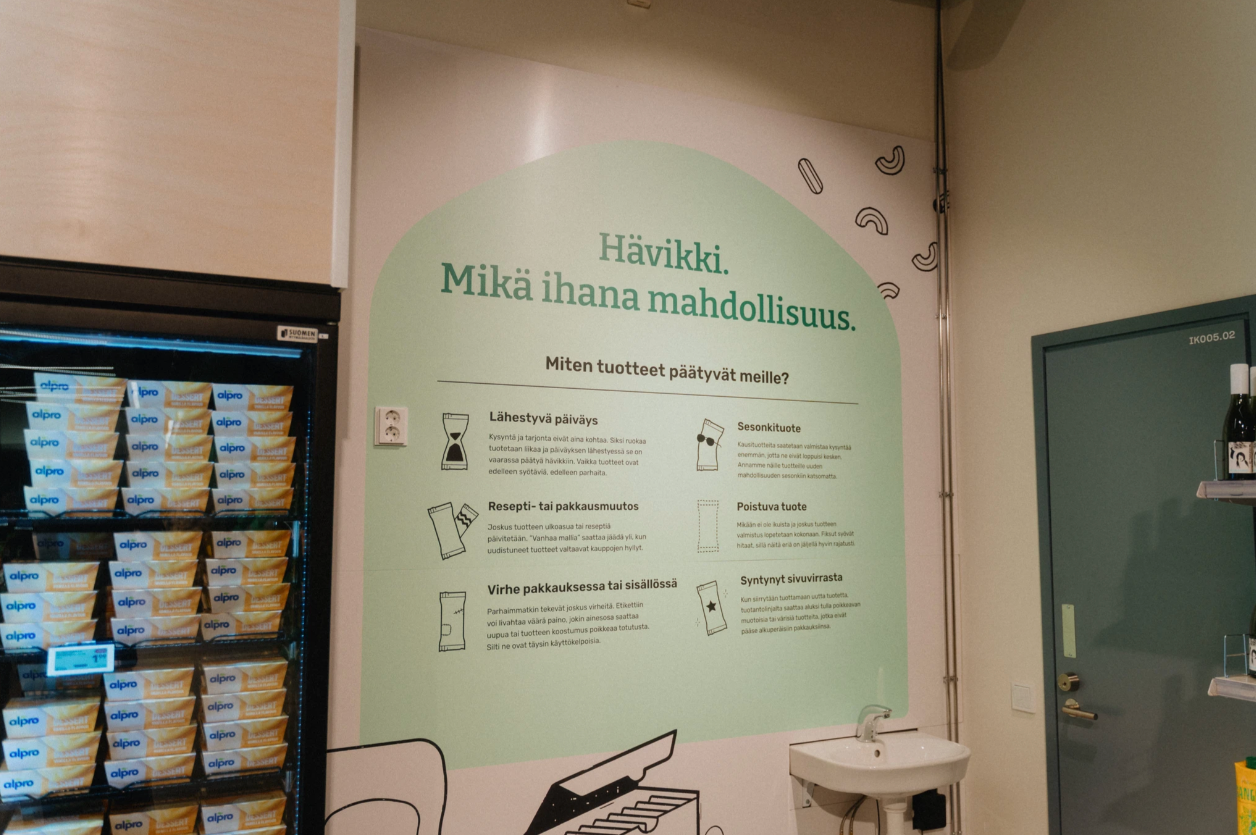
While Henni worked on the visual environment, Henriikka focused on how to bring customers through the door. It required a shift from digital-first thinking to understanding how people behave in a shopping centre.
For Henriikka, the work began with building the entire launch strategy from zero:
“I tried to keep customer glasses on from the beginning,” she says. “Who are the people walking past the store? What do they value? Where will they notice us? What channels should we use to reach them?”
She drafted both an ideal launch plan and a bare-minimum version to compare what different levels of investment could achieve. The PR angle turned out to be one of the most important parts — and also the most challenging.
Working with colleagues like Riku, CEO Juhani Järvensivu, and Store Manager Kai Kuokkanen, they identified new narratives that resonated strongly in the media. The PR launch was eventually executed in two phases: first a business announcement, and then a consumer-focused story ahead of the opening. Both succeeded far beyond expectations.
On top of all this, Henriikka coordinated with the procurement team to select the right launch products and worked side-by-side with the marketing team, ensuring every channel — from paid ads to influencer marketing handled by Tuomas Volanen, Digital Marketing Manager — aligned with the core concept and customer experience.
From the beginning, the whole team aligned around a clear goal: to create a fresh, professional, surprising and modern surplus food store.
Henriikka explains that many people still have outdated images of surplus food shops. “We wanted to challenge that perception,” she says. “This is not a charity shop with a few products on the shelf. This is a real store – fresh, modern, and full of great finds.”
Henni adds that they also wanted to highlight the constantly changing selection, turning the store visit into a miniature treasure hunt. “You never know what you might find,” she says. “It’s part of the experience. It’s meant to be exciting.”
This philosophy shows up everywhere — in the entry signage (“Start your treasure hunt here”), in the rotating displays, and in the playful product placements that change regularly.
.png)
Both Henni and Henriikka talk about how much they learned from the wider project team. A physical store launch requires expertise from every corner of the company. Procurement calculated store volumes and launch products, the data team built electronic price labels, and the store operations team worked closely with Riku and Kai to shape the store concept.
“My eyes were really opened,” Henriikka says. “You realise how small your own part is compared to everything happening around it. The level of talent in this company is incredible.”
Henni felt the same. “Most of us were doing something we’d never done before,” she says. “Yet everyone just made it work. You could fully trust that people did what they said they would do.”
For both, the project came with its share of smooth moments and tough ones.
Henni felt that the production side — creating materials and managing print work — came naturally. Henriikka, in turn, found that mapping out the big picture felt intuitive.
The difficult parts were often the ones tied to uncertainty: budgeting with many fixed costs, shaping the right PR angle, and navigating the complex ecosystem of a shopping centre with multiple stakeholders and requirements.
And then there was the constant need to prioritise. “We simply had to leave some things undone,” Henriikka says. “Everyone in the marketing team was involved, and we had to make choices about what we could realistically deliver.”
Nothing quite matched the feeling of opening day.
“When we saw the queue forming, it was such a relief,” Henriikka says. “The first customer had arrived at five in the morning. Seeing the line grow was incredibly proud moment.”
Henni describes the moment as surreal. “We built this,” she says. “I still go there sometimes, but I can’t behave like a normal customer. I’m straightening price labels and scanning the signage.”
Even now, months later, both still feel that rush of pride whenever they walk into the store.
When asked what they would tell someone offered a similarly challenging, first-of-its-kind project, both answer without hesitation.
“Go for it,” they say. “Take the opportunity. Ask questions. Get help from people who’ve done it before. You’ll learn so much.”
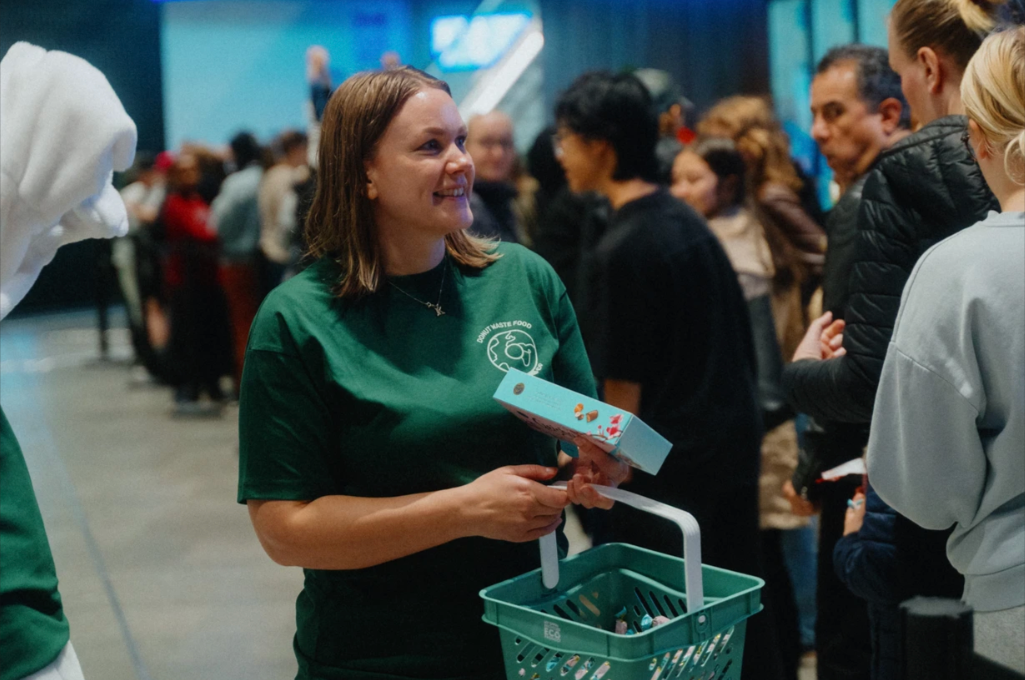
Cross-functional work made the impossible possible. “I was amazed by how incredibly talented our people are, and how everyone’s piece fits together in ways you don’t even see at first,” Henriikka says.
A clear, customer-first experience can reshape perceptions entirely. “We wanted people to walk in and realise this is a real, fresh, modern store, not the stereotype they might have of surplus food,” Henni explains.
Stepping outside your comfort zone is where the real learning happens. “So many of us were doing things we’d never done before, and somehow everything just worked because we trusted each other,” Henni says.